Strides: your first speed work
Updated 20 September 2026
Strides are short, fast, relaxed runs of 20 to 30 seconds with a full recovery between them. They are the standard first step into speed work for distance runners: the injury risk is low, the time cost is two to four minutes of fast running per session, and the effect on running economy shows up within a few weeks. This plan adds three stride sessions a week to the runs you already do. It is written for runners who train three or four times a week at an easy pace and have not done structured speed work before.
The plan runs six weeks in two blocks. Weeks 1 to 3 use hill strides only, which build leg power with less impact than running fast on the flat. Weeks 4 to 6 introduce flat strides, where speed and cadence are highest and your legs learn the full movement. Nothing is removed from your week. Each session is an easy run you were going to do anyway, with strides at the end.
What a stride is
A stride is a controlled acceleration to about 3K to 5K race pace, held for 20 to 30 seconds, followed by enough recovery to feel fresh again. It is not a sprint. You build speed over the first five seconds, hold a fast but relaxed effort through the middle, and ease off at the end. Your form stays the same as in normal running: upright, shoulders down, arms moving normally.
It is also not an interval. An interval session repeats efforts of several minutes until you accumulate fatigue, and that fatigue is what drives the adaptation. A stride is over before fatigue builds. You recover fully, then repeat. The stimulus is the speed itself, applied to fresh legs. That is why strides are safer than intervals and why they belong before intervals in a runner's development.
Why strides work
Runners who train at one pace develop one movement pattern. Strides expose the neuromuscular system to a faster pattern, more force per step and shorter ground contact, and that carries over to easier paces. The measurable result is better running economy: less oxygen for the same speed.
The effect is well documented. In Barnes et al. (2013), 20 well-trained runners added two uphill sessions a week for six weeks. The group doing the shortest, steepest efforts improved running economy by 2.4%. In Skovgaard et al. (2018), 20 trained runners replaced part of their mileage with ten sessions of 30-second efforts over 40 days. Running economy improved 2.1% and 10K time improved 3.2%, with no change in VO2 max. Two to three sessions a week are needed. A 12-week study using one sprint session a week found improved leg stiffness but no significant change in economy.
What changes in your week
Strides are added to the end of three runs. The runs themselves do not change. For a runner on four runs a week, the week looks like this:
| Day | Current week | With strides |
|---|---|---|
| Tue | Easy run 40 min | Easy run 40 min, then 6 × 20 s hill strides |
| Thu | Easy run 40 min | Easy run 40 min, then 6 × 20 s hill strides |
| Fri | Easy run 30 min | Easy run 30 min (optional: 4 × 20 to 30 s hill strides) |
| Sun | Long run 70 min | Long run 70 min, then 6 × 20 s hill strides |
The six-week plan
Three sessions a week on Tuesday, Thursday and Sunday, with an optional fourth on Friday for runners who already run four times. Reps progress from six to eight in the hill block and from four to eight in the flat block. Stride duration stays between 20 and 30 seconds throughout. The progression is in repeatability and terrain, not in longer efforts.
Weeks 1 to 3: hill strides
All strides in this block are run uphill on a grade of 4 to 8%. The incline reduces impact forces and lets you produce high power at a lower speed, so your legs adapt to fast running before they take the full load of the flat. This three-week hill block follows the adaptation protocol used by coaches David and Megan Roche, who start every athlete on hills for this reason. Do not add intervals or tempo runs during these three weeks. You are introducing one new stress, and it should be the only one.
| Week | Tue | Thu | Sun |
|---|---|---|---|
| 1 | 6 × 20 s hill | 6 × 20 s hill | 6 × 20 s hill |
| 2 | 6 × 30 s hill | 6 × 20 s hill | 6 × 20 s hill |
| 3 | 8 × 30 s hill | 8 × 20 s hill | 8 × 20 s hill |
Optional Friday session for four-run weeks: 4 × 20 to 30 s hill strides, same hill, same recovery.
Weeks 4 to 6: flat strides
Tuesday and Sunday move to flat ground. Thursday stays on the hill so you keep one lower-impact session a week. Flat strides carry more impact than hill strides, so they start at four reps and build to eight over three weeks, and they are run only on days when you feel fresh. From week 4 you may reintroduce intervals or tempo runs if they were part of your training. Strides the day before a hard session work well as a primer.
| Week | Tue | Thu | Sun |
|---|---|---|---|
| 4 | 4 × 20 s flat | 6 × 20 s hill | 4 × 20 s flat |
| 5 | 6 × 20 s flat | 6 × 30 s hill | 6 × 20 s flat |
| 6 | 8 × 20 s flat | 6 × 30 s hill | Loop test, then 4 × 20 s flat |
Hills-only option for runners over 50, runners with a history of soft-tissue injury, or anyone who prefers it: run every flat session as a hill session with the same reps. Many masters athletes never move to flat strides and keep the full benefit.
How to run a hill stride
Hill strides are about power. The movement is closer to bounding than sprinting: a strong push off each foot, knees driving up, cadence close to your normal running cadence.
- 1Choose a hill of 4 to 8%. It should be steep enough to feel, but not so steep that your posture changes.
- 2Accelerate over the first 5 seconds. Do not start at full effort.
- 3Build to the strongest push you can hold with relaxed shoulders and normal arm swing. Stop short of a sprint.
- 4Hold for 20 to 30 seconds, then jog down and continue easy until you feel fully recovered, usually 60 to 90 seconds. If in doubt, rest longer.
How to run a flat stride
Flat strides are about speed and coordination. Cadence rises and ground contact time drops. Because the impact is higher, flat strides begin in week 4, after the hill block, and only on days when your legs feel fresh.
- 1Find 100 m of flat, straight, even ground. Track, path or quiet road. Avoid rocky or rooty trail.
- 2Accelerate smoothly over the first 5 seconds, lengthening the stride before quickening it.
- 3Hold about 3K to 5K race pace for 20 seconds with an upright posture, normal arm swing and relaxed hands and jaw. Focus on pushing off the ground rather than on moving your feet faster.
- 4Ease off, then jog easy for 1 to 2 minutes before the next one. On an easy run, do the strides at the end. On a long run, do them before the 75-minute mark, while your legs are still fresh.
Judging the effort
The target is about 3K to 5K race pace. If you have run a parkrun or a timed 5K, a stride is slightly faster than that pace. If you have not, use this test: the effort should be too fast to talk through, but your shoulders, hands and face should stay relaxed. Any sign of straining means you have crossed into a sprint. Ease off on the next rep.
Check the last rep against the first. If the sixth stride feels like the first, the effort and the recovery are right. If you are tightening up by the fourth, either slow the remaining strides slightly or take longer recovery. Extra recovery never hurts a stride session.
Common mistakes
- 1Sprinting. Strides are fast and relaxed, not all-out. Sprinting raises the injury risk and does not add benefit.
- 2Cutting the recovery short. Each stride should start on fresh legs. If you are still breathing hard, wait.
- 3Extending the duration. Efforts longer than 30 seconds become intervals and bring the fatigue this plan is designed to avoid.
- 4Starting on the flat. The hill block exists to prepare your legs. Skipping it moves the impact forward before you are ready.
- 5Adding strides to every run. Two or three sessions a week is the effective dose. More adds fatigue without adding benefit.
- 6Running strides in race week or through pain. Skip them in the week of a race and whenever anything hurts.
Measuring progress
Running economy is measured in a laboratory, but you can track the same change in the field. In week 1, run an easy loop you know well at your usual easy heart rate and record the pace. On the last Sunday of week 6, run the same loop at the same heart rate. A faster pace at the same heart rate is the improvement in economy.
After the plan
To keep the adaptation, keep two stride sessions a week: one flat session on a day when you feel fresh, and one hill session on a day when you are tired. This is the maintenance dose used year-round by the coaches whose protocol the hill block comes from. If you plan to add intervals or tempo runs, your legs are now prepared for them. Strides the day before a hard session continue to work as a primer.
The plan at a glance
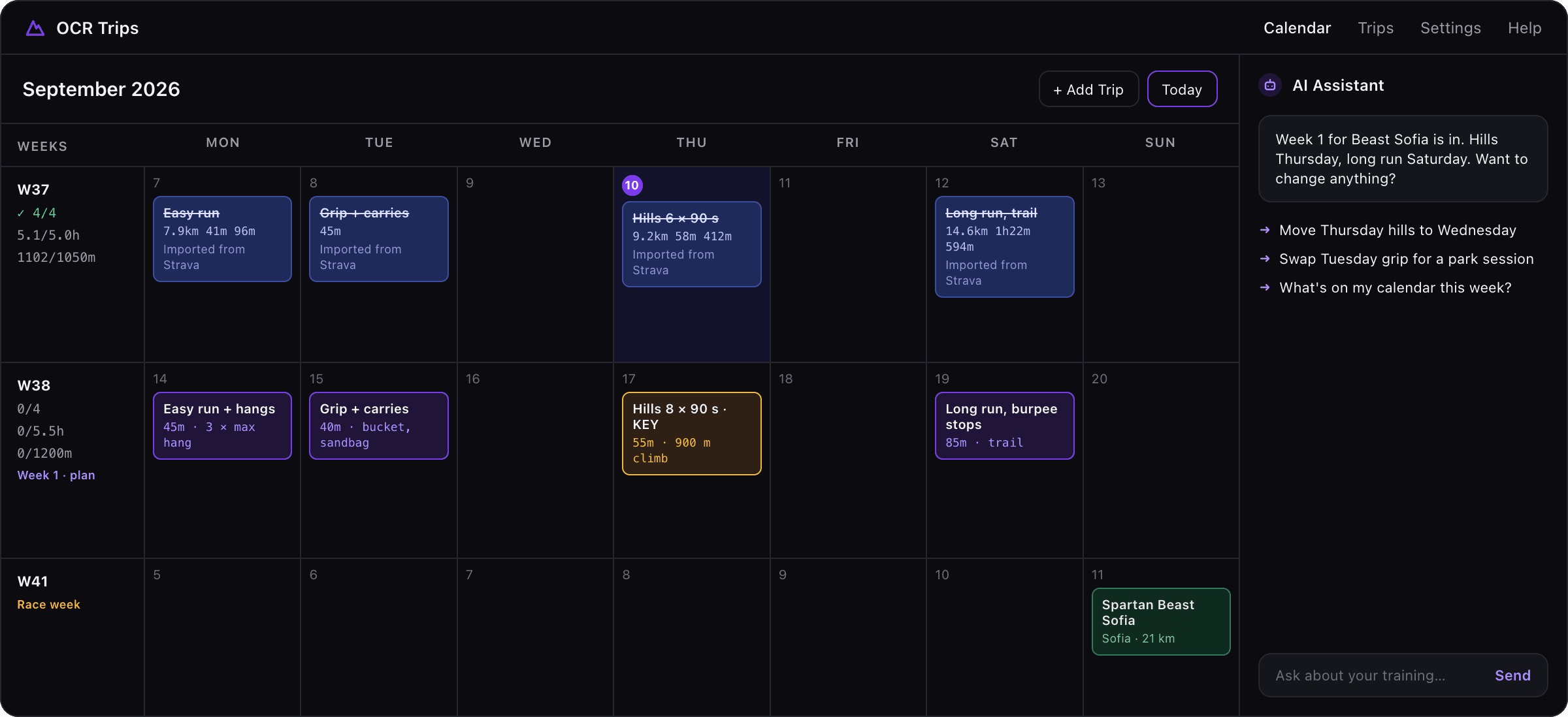
All 18 sessions as they land on your calendar, week by week. The start date is yours; the days can be moved once the plan is on the calendar.
Questions
Can I run this alongside a race plan?
Yes. Add the strides to the end of easy runs and leave the key sessions of your race plan unchanged. During weeks 1 to 3, drop intervals and tempo runs. From week 4, run strides the day before a hard session. Skip strides in race week.
I am over 50 or have a history of injury. Should I do the flat block?
Use the hills-only option. Keep the same weeks and reps and run every flat session as a hill session.
I do not have a hill nearby.
Any slope of 4 to 8% that you can run up for 30 seconds works: a bridge ramp, a car park ramp, or a treadmill at 5%. If there is no slope available, start on the flat with 4 × 15 s, accelerate over 5 seconds, and stay well short of a sprint.
Road or trail?
Road for flat strides. The point is to put as much force into the ground as you can, and a firm, even surface is what lets you do that. For hill strides, trail is fine if you have no road hill nearby. Pick a smooth line and expect a slower pace.
I only run twice a week.
Run strides on both runs. Two sessions a week is the minimum effective dose.
What happens after week 6?
Keep two stride sessions a week to maintain the gain, or stop and repeat the plan before your next race build.
Strides: your first speed work
Free · 6 weeks · 18 sessions · 3 days a week